Secondary Research

As I conducted secondary research for my ethnography project, I came across many similarities with my own findings. One article that I came across titled, “First-Generation College Students More Engaged Than Peers,” states much about the perceptions of first-generation students. Stereotypically, the demographics of first-generation students consist of Latino descent, lower class families, students from large families, etc. Many of the subjects in which I interviewed and surveyed were of Latino descent and some were of lower class families. After reading several articles regarding first-generation students, it is clear that many of them feel an obligation to graduate college because of their parents. In the article stated above, one first-generation student stated, ““When I graduated I had 18 people there, because I was the first to do it. Everyone wanted to celebrate, but with that came an incredible amount of pressure. I went to college with my mom, my dad, four other siblings … and a bazillion cousins.” There is consistency in the fact that these students feel obligated to graduate college since they are the FIRST ones to do so in their families.

In another article, “Breaking Down Barriers: First Generation College Students and College Success,” it states, “First-generation students often require developmental coursework and tend to have lower grade point averages than their peers with college-educated parents.” First generation students tend to suffer in terms of grade point averages as a result of the new and unfamiliar environment in which they are placed in. First-gen students benefit when given resources to help them academically. According to my interviews and surveys, first-gen students at Chapman use resources given to them to help with academics. Therefore, there are no holes or gaps between my primary research and secondary research. It also matches with both my experience and knowledge on the topic.

First-Generation Students

  1. What is your topic? (What sub-community do you plan on investigating?)
    • I plan on investigating the first generation student community. At Chapman University, a first generation student is defined as a student whose parent(s)/legal guardian(s) have not completed a bachelor’s degree.
  2. What are your driving research questions?
    • Does this community have an overall advantage in terms of resources in comparison to non-first gen students? If so, what are those advantages? Does this community face more struggles in the process of applying to colleges when compared to non-first gen students? If so, what are those struggles?Do first-generation students feel a sense of belonging at Chapman University? If not, why? Does being a first-gen student give you more motivation to get a bachelor’s degree? If not, why? Does being a part of this community benefit its members? If so, how?
  3. Whom do you plan to use as the subject for your project? (They should be Chapman students, as well as members of your chosen sub-community)
    • I, myself, am a first-generation student and since I am a part of clubs for first-gen students such as Promising Futures and First Gen Ambassadors, I can use my fellow members as the subjects for this project.
  4. In addition to the required interviews and observations, what other research methods do you plan to use in your research? (secondary research, anonymous surveys, questionnaires, field notes, etc.)
    • In addition to the required interviews and observations, I plan on creating a few surveys to send out to some first-gen students. A lot of my close friends are also first-gen so sending them my survey will be quite easy. The survey will most likely be made on google docs so it can be easily shared through email. I can easily interview first-gen students since I have made connections to so many of them. Some sample questions include whether or not they have faced struggles while applying to college and/or do they use resources on campus for first-gen students? Also, I can take notes of the interactions I see at Promising Futures and First Gen Ambassadors meetings.

A Cub In a Lion’s Den

I felt like a cub walking into a lion’s den.

Entering college was a very terrifying event for me especially since I am out-of-state student and to be completely honest, my main concern was the social aspect of college. Are all of the in-state students going to hang out with other in-state students?

These were my thoughts.

Questions like what cliques form in college, where can I find my “crowd,” will I make friends in clubs? And that was when I found the Promising Futures Program (PFP) for first-generation students. In this program, I found, in essence, my “crowd.” I became friends with the people who I now consider my closest friends. Going to PFP mixers and meetings led me to meet some of the most amazing people and faculty.

In simple terms, the answers to my questions were no-not every in-state student hangs out with other in-state students, no-cliques do not really form in college, anywhere-you can find your “crowd,” yes-you can find your “crowd” in clubs. Joining PFP most definitely rectified my fears.

As I spoke to the Orange High students, I found that their concerns/fears were quite similar to my other concerns. Many of their concerns revolved around the idea of financial aid and time management. Financial aid really came into play when choosing a college and there are still some days where I constantly remind myself of my student loans, tuition fees, etc. The only solution to this concern would be to keep up your grades (for scholarships) and apply for a TON of outside scholarships. In terms of time management, I was quite conscious of it in high school. I constantly planned out my homework, days, and extracurriculars. My only advice for the OHS students was to PLAN. Get a planner and write down every assignment, meeting, and exam.

“Theater Kids” versus “Smart Kids”

In school, I remember hearing the clear distinction between “the science kids” versus “the theater kids.” “Theater kids” were the ones who excelled in their art, music, and dance classes while the “science kids” excelled in their science and math classes. This may seem like a terrible thing to do to students, but it was quite true. Some students were better at certain things than others and it’s completely fine to shine light on that.

If a student has skills in the arts, why make them suffer in classes like biology and chemistry and why make students who like the sciences suffer in classes like choir?

Public schools have a terrible way of working around the idea of different forms of intelligence. As a freshman in high school, I basically already had the next four years of my life set up; 3 years of science, 4 years of english, 3 years of math, 1 year of art, and 2 years of history. Personally, I enjoyed both the sciences and arts so my next four years didn’t seem too bad, but one of my friends despised science, but in the eyes of public schools, she had to suffer three entire years of science.

It is a great idea to open students up to a wide range of classes, but to force them is a different story. Also, with the idea of only one year of art required, it seemed as if public schools emphasized analytical intelligence rather than creative or practical.

In my opinion, public schools should foster all forms of intelligence, but in a way, that doesn’t force students into certain paths. For example, if students want to focus on their creative intelligence, then let them. With the current system, students can be stripped from their creative abilities. Talented artists can be discouraged from working in the arts because of the notion that analytical or practical intelligence are superior.

“Theater Kids”
“Science Kids”

A + B = C

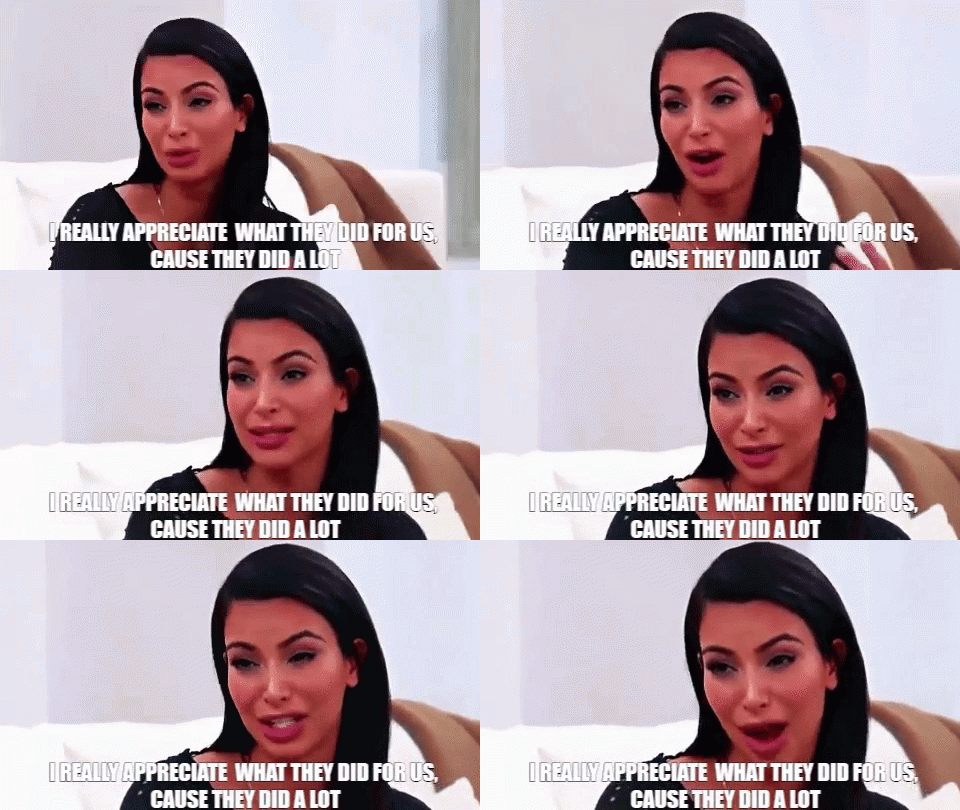
Fame and success; two things that are yearned for by a number of people. In a perfect world, we would love to think that these two things come from true intelligence or talent, however, in many situations, that isn’t the case. This is a horrible example, but think of the Kardashians. Yes, they may be incredible business women, but how did these women get to where they are at? Some may say because of Kim, but how did she get to where she is at? Well, a one-word answer would be ‘opportunity.’ Her most notable opportunity being her friendship with Paris Hilton. Think about it… where would Kim Kardashian be if it weren’t for her relationship with Paris? This friendship was a startup for numerous things; business deals, modeling contracts, etc.

The thing to keep in mind though is that opportunities are only effective if you take them. Taking every opportunity is a key to success and potential fame. Yet, intelligence and talent are also significant when it comes to success. Many opportunities branch from intelligence and talent. For example, if you are a very talented singer, you may be given opportunities to perform in talent shows, competitions, and maybe even given a record deal. So, what I am trying to say is that it is a mix of opportunity, intelligence, and talent that truly leads to success.

To be successful, it is not only about one of those three factors, it is about multiple of them. It is about having opportunities and those opportunities may have stemmed from talent or intelligence. If you really want to be successful, do not rely on only opportunity or only on your talent. You need to use your talent or intelligence to gain opportunities to ultimately lead you to success.

Think of success as a math equation; A+B=C. Well, talent/intelligence + opportunity = success.

Open Letter Proposal to Mrs. Prime

  1. My Topic:
    1. For my open letter, the main focus will be the fact that my teacher saw that I was being held back in mediocre classes, so she transferred me to advanced classes. This transition to upper-level classes laid the foundation to my educational journey.
  2. My Audience:
    1. The specific audience for my open letter will be my fifth grade teacher, Mrs. Prime. The broader, intended audience of my letter will be other teachers and possible school administrators.
  3. My Purpose:
    1. With this letter, I hope to encourage both teachers and administrators to really get to know their students and their capabilities. Encourage students to always do better. Reward students for good behavior. Don’t just walk into your classroom and see 20 students, see strengths and weaknesses, likes and dislikes, capacity, incompetence, etc.
  4. My Tone/Persona:
    1. In this piece, I plan to give off my sense of gratitude and also an assertive tone in which I hope to use to fulfill my purpose stated above. Throughout this letter, I will show the reader how impactful Mrs. Prime’s decision to transfer me out of her class was and still is to my educational journey. As stated, it is crucial to highlight my gratitude to Mrs. Prime. In order to achieve this, I will use many anecdotes and descriptive diction.

A Prime Example of a Great Teacher

Imagine this; it’s the beginning of your fifth grade year, you walk into a classroom, and find yourself in a classroom with not only one teacher, but three. This may not seem like a terrible thing to most people, but in my middle school, the more teachers you had, the worse of a student you were. Having the teacher aides allowed for students to get help with whatever they needed. I, however, felt a rush of anxiety and shame knowing that three teachers equaled one very bad student.

As the term went on, assignments seemed to breeze by. I enjoyed the work. My exam scores were pretty high and I honestly just thought to myself; “What am I doing in this classroom?”

One particular day that I will always remember, my teacher (the main one) had pulled me aside and the first thing she said to me was, “This class is holding you back.” Now imagine this; a ten year old kid hearing confusing words like this class is holding you back. What did that even mean? Did I not belong here?

A mere month after that, I was transferred to another class with a new group of students. From the moment I walked into this new jungle of ten year olds I was mesmerized by calm, studious, and hard working students. There were no longer rowdy and needy students who could care less about grades and schoolwork. Oddly enough, I felt a sense of belonging. I belonged here. No where else but here.

From then on, I was placed into classes known as G&T or, in other words, Gifted and Talented. I was gifted. I was talented.

Looking back now, as a college student, I owe all of my educational journey to that one teacher, Mrs. Prime. It’s funny to think her last name is ‘Prime.’ Some synonyms of the word ‘prime’ are top-quality, high-grade, and excellent. Those are only a few of the many words I could use to describe Mrs. Prime.

She believed in me and saw things in me that I never could see. She saw qualities in me that I didn’t even know how to put into words.

During my sophomore year of high school, I was getting inducted into the National Honor Society and one component of this eventful night was to recognize a teacher who had made an impact on us. Immediately, I thought of Mrs. Prime. A few email exchanges and even phone number exchanges, we had finally come in contact after almost seven years.

Acknowledging her that night was incredible and I could not be more grateful for everything she has done. To be honest, we still keep in contact today. She texted me encouraging words when I was applying to schools. I texted her when I got accepted to Chapman. She texts me to keep updated on classes and grades. I texted her when I figured out I wanted to major in English and Communication, which she did as well.

Learning and Writing Everyday

About Me: My name is Jenisty Colón and I am from the good ole’ state of New Jersey. I am an avid movie watcher and book reader, which leads my favorite place to be Barnes and Noble. La La Land is the absolute best and no one should think otherwise. Also, ask me what my favorite book is and I can go on for 3,578 hours. The purpose of this blog is to express my opinions and hopefully teach my readers something about myself with every post.